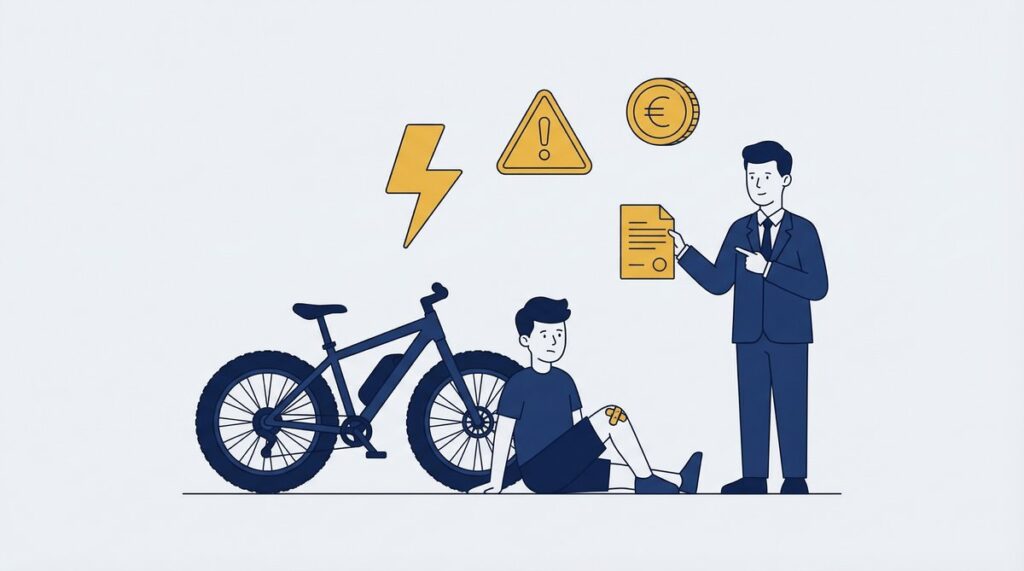

After a fatbike accident, personal injury can arise for the rider, a passenger, a cyclist, a pedestrian or another road user. Who is liable and what damage can be recovered does not depend on the word “fatbike” alone. The technical characteristics of the vehicle, the traffic situation, how the accident happened and the available insurance can all matter.
This article gives a general overview. For a concrete assessment, photographs, witness statements, police records, medical information and details of the vehicle are important, among other things.
First the question: which vehicle category does the fatbike fall into?
A fatbike can meet the characteristics of an electric bicycle. According to the RDW, an electric bicycle has pedal assistance, a motor output of at most 250 watts, and assistance that stops when you stop pedalling or ride faster than 25 kilometres per hour. In principle, bicycle rules apply to an electric bicycle.
Not every fatbike meets those characteristics. Where a throttle drives the vehicle without pedalling above 6 kilometres per hour, or where assistance continues above 25 kilometres per hour, central government indicates that the fatbike may have to be approved as a speed pedelec, moped or light moped. The RDW states that for vehicles not meeting the e-bike requirements a registration plate, helmet, driving licence and insurance may be compulsory, among other things.
So the technical characteristics matter. A wide tyre or the commercial name “fatbike” is not decisive.
What does this mean for liability after an accident?
Liability after a fatbike accident depends on the circumstances. The vehicles involved, the vehicle category, the traffic rules, the position on the road, the speed, the conduct of both parties and the available evidence can all play a part.
In a collision between a motorised vehicle and a cyclist or pedestrian, different liability rules may be relevant than in a collision between two cyclists. If the fatbike is legally a motor vehicle, that can affect the insurance obligation and the assessment of liability. It does not mean every case has the same outcome, or that a single statutory article automatically determines who pays.
When is third-party liability insurance compulsory?
The insurance obligation for motor vehicles follows from the Motor Insurance Liability Act (WAM). In short, Article 2 WAM provides that the possessor and registered keeper of a motor vehicle must take out and maintain insurance in the circumstances set out there.
According to central government, an ordinary electric bicycle meeting the e-bike requirements falls under the bicycle rules and carries no third-party insurance obligation as a motor vehicle. A fatbike that does not meet those requirements may have to be approved as a speed pedelec, moped or light moped. Different rules then apply. The exact classification of the vehicle must be established carefully.
What if the fatbike is not insured?
A tuned or unapproved fatbike may fail to meet the rules for public roads. The RDW and central government warn that a rider may then be uninsured and that damage can come at their own expense. For a victim that does not automatically mean there is no route to recovery, but it does mean the route can be more complex.
Where damage is caused by a motor vehicle and no insurer pays, the Dutch Motor Traffic Guarantee Fund can be relevant in some situations. The fund names unknown, uninsured and stolen motor vehicles, among others. Where the motor vehicle is known but uninsured, the fund advises first holding the person responsible directly liable. Whether a claim on the fund fits depends on the statutory conditions and the facts of the case.
Which heads of damage can play a part in a personal injury claim?
Various heads of damage can arise in a personal injury claim: unreimbursed medical costs, travel costs, household help, loss of income, study delay or non-material damage. Whether a head qualifies for compensation depends on liability, the supporting evidence, the connection with the accident and the reasonableness of the costs.
There is no fixed compensation for a fatbike accident. The size of any award is always assessed in the light of the concrete consequences and the available evidence.
What can you do immediately after a fatbike accident?
- See to medical help first if that is needed.
- Note the names, contact details and positions of those involved and of witnesses.
- Photograph the location, the vehicles, any damage and relevant traffic situations if it is safe to do so.
- Note details of the fatbike, such as make, type, registration plate if present, technical characteristics and any modifications.
- Keep medical documents, receipts, travel costs, correspondence and information about work or income.
- Report the damage to the relevant insurer in good time, or seek advice on the right route.
Evidence about the fatbike’s technical characteristics
How a fatbike is classified can be important. So keep information about the motor, the maximum assistance, any throttle, type approval, registration plate and modifications to the vehicle. The RDW points out that if you are in doubt about a vehicle without a registration plate, you can ask the manufacturer whether a type approval exists. A Certificate of Conformity can be relevant here.
Do not rely on the sales name alone or on a statement from someone involved. The technical properties and the actual situation are decisive for a careful assessment.
Frequently asked questions about fatbike accidents and personal injury
Is every fatbike a motor vehicle?
No. According to the RDW and central government, a fatbike meeting the characteristics of an electric bicycle falls under the bicycle rules. If the vehicle does not meet those characteristics, it may have to be approved as a speed pedelec, moped or light moped. The technical characteristics are decisive.
Is third-party insurance always compulsory for a fatbike?
No. For an electric bicycle meeting the e-bike requirements, central government names no third-party insurance obligation as a motor vehicle. For a vehicle that must be classed as a speed pedelec, moped or light moped, other rules and an insurance obligation may apply. If in doubt, have the vehicle category checked.
Can I recover personal injury damages if an uninsured fatbike hit me?
That cannot be answered in general terms. It depends on the vehicle category, how the accident happened, liability, whether the person responsible is known or unknown, and the available route to recovery. Where damage is caused by a motor vehicle, the Motor Traffic Guarantee Fund can be relevant subject to conditions. Where the motor vehicle is known but uninsured, the fund advises first holding the person responsible directly liable.
Does Article 185 of the Road Traffic Act always apply to a fatbike accident?
No. The application of liability rules depends on the specific vehicles involved, the legal classification of the fatbike and the circumstances of the accident. Article 185 is not the basis of the insurance obligation; for motor vehicles that follows from Article 2 WAM.
How much compensation for pain and suffering will I receive after a fatbike accident?
There is no fixed amount for that. The assessment depends on the injury, the consequences for work and daily life, the length of recovery, medical information and the circumstances of the case, among other things.
Sources
- RDW: electric bicycle or speed pedelec
- Central government: rules for electric bicycles, e-bikes and fatbikes
- The Motor Insurance Liability Act (WAM)
- Waarborgfonds Motorverkeer
Read also
- Personal injury as a cyclist after being hit by a car
- Fatbike accident: liability and claiming personal injury damages
- Who pays personal injury damages after an accident involving a fatbike?
Need help?
Do you have a personal injury after a fatbike accident? Arslan Advocaten can assess what information is needed to examine liability and the possible route to recovery. That assessment always depends on the facts, the vehicle category, how the accident happened and the available documents.
The Arslan Advocaten blog deals carefully with liability and compensation after a fatbike accident, correctly distinguishing between regular e-bikes and unapproved or tuned fatbikes. To frame the legal circumstances more sharply still, the differences between traffic accidents, workplace accidents, medical liability and loss of income can be linked explicitly to the fatbike file.
| Personal injury context | Legal framework and relevant rules | Points to watch in fatbike personal injury cases |
|---|---|---|
| Traffic accident | Road Traffic Act (WVW) art. 185, Traffic Rules and Signs Regulations (RVV), Motor Insurance Liability Act (WAM). | How the fatbike is classified (e-bike versus light moped/moped) determines whether it is a motor vehicle and whether third-party insurance is compulsory. |
| Workplace accident | Dutch Civil Code art. 7:658 (the employer’s duty of care). | Applies where the employee had an accident on a fatbike during working hours (meal delivery, for example). |
| Medical liability | Dutch Civil Code art. 7:446 et seq. (the Medical Treatment Contracts Act) and art. 6:162 / 6:170. | Relevant where the injury worsens after the fatbike accident through a medical error in hospital. |
| Loss of income | Dutch Civil Code art. 6:95 et seq. (patrimonial loss, loss of earning capacity, study delay). | Requires precise substantiation of actual versus hypothetical income, taking residual earning capacity and UWV schemes into account. |