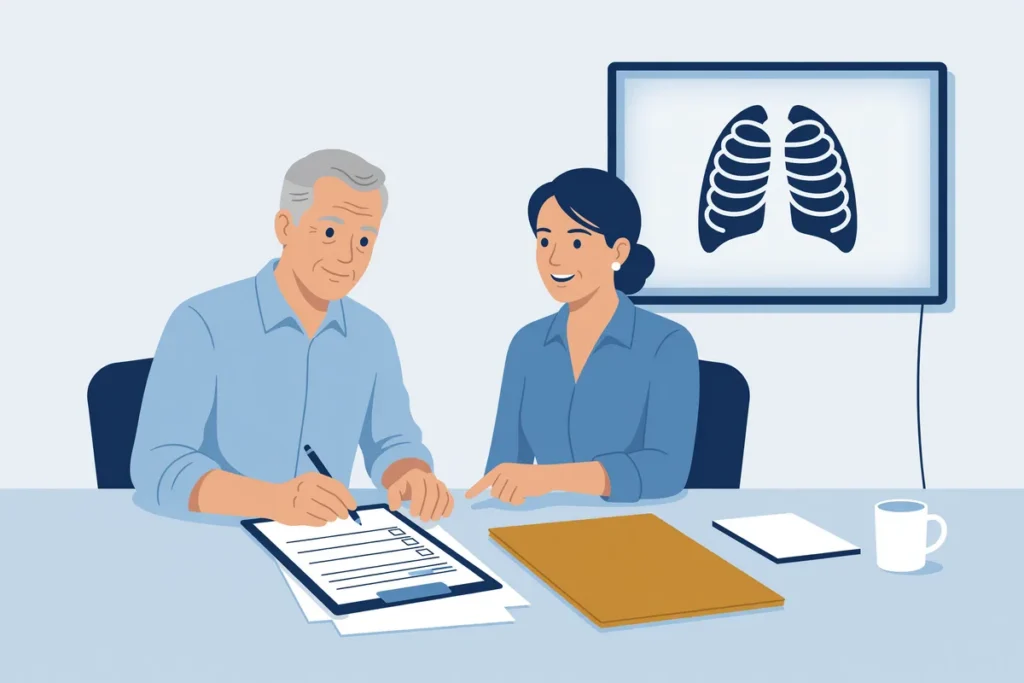
TSB is a Dutch government scheme for designated occupational diseases involving hazardous substances. The one-time payment is € 27,030 in 2026, subject to its conditions. Applications go through ISBG; the Social Insurance Bank (SVB) makes the final decision and pays. It is not the same as a full civil damages claim against an employer and does not automatically establish liability.
Written by Onur Arslan, attorney at Arslan Advocaten. Registered in the specialisation register of the Netherlands Bar for employment law and personal injury. Last updated: 1 October 2026.
The designated disease groups
The 2026 list covers allergic occupational asthma, CSE, lung cancer caused by asbestos, lung cancer caused by silica, nasal or paranasal sinus cancer caused by wood dust, and silicosis. Each category has medical assessment conditions. A general symptom or suspected exposure is not automatically enough.
Mesothelioma and asbestosis are not on the TSB list; for these diseases the asbestos schemes of the Institute for Asbestos Victims (IAS) may apply. Check your actual diagnosis rather than selecting a route merely because asbestos exposure occurred.
Work history and the scheme conditions
The scheme concerns qualifying hazardous-substance exposure during relevant work in European Netherlands under Dutch law. The work must have been done as an employee or as a self-employed person without staff. An expert panel of Lexces confirms whether the diagnosis meets the scheme; ISBG advises and the SVB decides.
If you already received a government payment for another substance-related occupational disease (for example under TSB, TAS, TNS or the CSE scheme), you are in principle not eligible. A payment from your employer or client for the same disease is deducted from the TSB amount, and if you later receive damages from them, part or all of the TSB payment may have to be repaid. Read the official ISBG conditions and provide accurate information about other applications and amounts received.
Prepare your evidence
List employers, work locations, dates, tasks and substances. Keep original product names and safety information if available. Label estimates and unknown values. A precise job description may be more useful than a broad statement that a factory was dusty.
Organise diagnosis and specialist information through the application route. Do not send full medical files to unrelated workplace contacts.
A civil claim is separate
A civil case assesses employer liability and personal loss, which can extend beyond the fixed scheme payment. One route does not guarantee the result under the other. Payments should be coordinated to avoid an incorrect calculation or treating already reimbursed loss as unpaid.
A TSB application does not automatically stop the limitation period for a civil claim. Have deadlines and potentially responsible employers checked separately.
Get the correct assistance
Use ISBG for the official application. Arslan Advocaten can review the possible employer liability route in a free first consultation on +31 70 450 0300. See occupational disease.
Frequently asked questions
Is € 27,030 the maximum value of my employer claim?
No. It is the TSB amount for 2026. A possible civil damages claim is assessed separately.
Does my employer have to admit liability first?
The scheme has its own assessment conditions. An employer admission is not the same decision as TSB eligibility.
Read also
Sources and legal basis
This page provides general information and is not legal advice about your own situation. Sources checked on 1 October 2026.