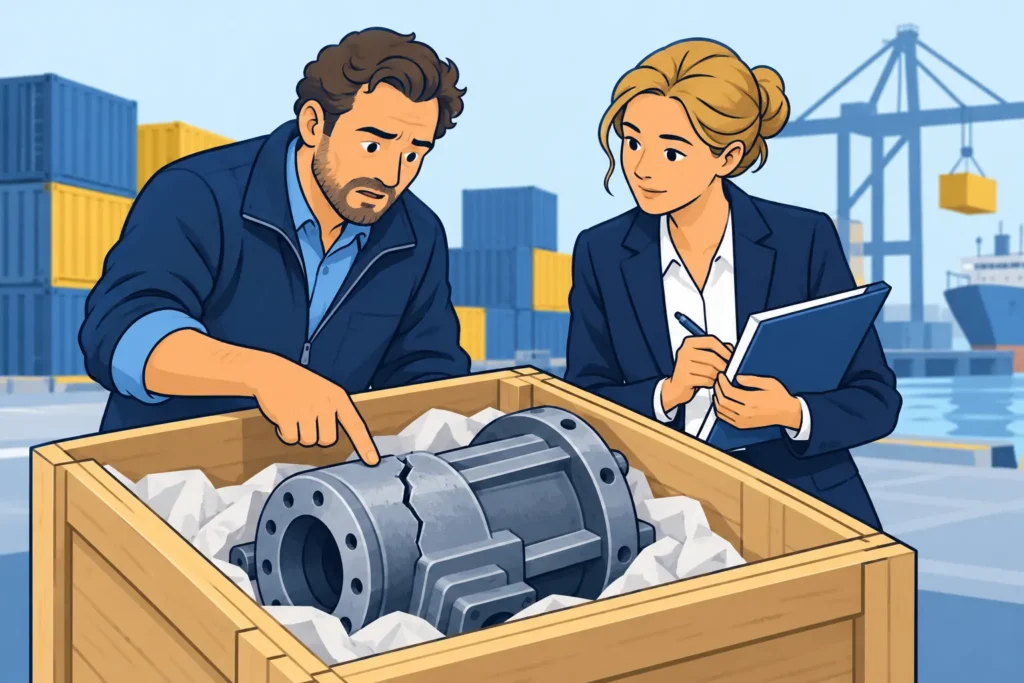
Force majeure (overmacht) arises where the other party fails to perform because of a cause for which it cannot be blamed and which is not for its account by virtue of the law, the contract or generally accepted views (Article 6:75 of the Dutch Civil Code). A party that rightly invokes force majeure does not have to pay damages. But force majeure does not mean that you, as the other party, are left empty-handed: in principle, you can still terminate the agreement.
Written by Onur Arslan, attorney at Arslan Advocaten. Registered in the specialisation register of the Netherlands Bar for employment law and personal injury. Onur Arslan practised for many years as a corporate lawyer and insolvency trustee (curator) and has extensive experience in financial law disputes. Last updated: 17 September 2026. Reviewed on 17 September 2026 against the statutory text on wetten.overheid.nl.
“We cannot deliver because of the storm.” “Because of rising raw material prices, performance is no longer possible.” “Our subcontractor has gone bankrupt, so this is force majeure.” The term is used quickly, often too quickly. This page explains when a force majeure defence holds up, when it does not, and what you can do in either case.
What force majeure means in legal terms
Every failure to perform in principle obliges the debtor to pay damages, unless the failure cannot be attributed to the debtor; force majeure is the name for such a non-attributable failure.
Article 6:74 of the Dutch Civil Code sets out the main rule: whoever fails to perform must compensate the loss, “unless the failure cannot be attributed to the debtor”. Article 6:75 of the Dutch Civil Code specifies when that is the case: if the failure is not due to the debtor’s fault and is not for the debtor’s account by virtue of the law, a juridical act or generally accepted views.
So there are two tests, and both must be met:
- No fault. The cause lay outside the debtor’s sphere of influence and the debtor could not reasonably have done anything to prevent it or limit its consequences.
- No risk. Even without fault, a cause may be for the debtor’s account: because the law says so, because the contract says so, or because, viewed from a societal perspective, it is the debtor’s risk.
A debtor who invokes force majeure must state the facts supporting it and, where necessary, prove them.
What is usually not force majeure?
Many causes presented as force majeure are, under the law or according to generally accepted views, for the account of the party invoking them.
| Alleged cause | Why this is, as a rule, not force majeure |
|---|---|
| Assistants or subcontractors fail to perform | The debtor is liable for them as for its own conduct (Article 6:76 of the Dutch Civil Code) |
| Machinery or materials used turn out to be unsuitable | In principle for the debtor’s account (Article 6:77 of the Dutch Civil Code) |
| Lack of money or payment difficulties | The debtor bears the risk of its own financial inability |
| Price increases or more expensive raw materials | Performance becomes more expensive, not impossible; that is a business risk |
| The debtor’s own supplier fails to deliver | Depends on the circumstances, but is often a business risk, particularly if alternatives were available |
| Foreseeable events | A party that could foresee a risk when concluding the contract has often accepted it |
Genuine force majeure usually concerns external events that could not be foreseen or prevented and whose consequences could reasonably not be absorbed: a government measure prohibiting performance, a fire not caused by the debtor, or an extreme natural disaster that also blocks alternative routes.
The force majeure clause in the contract
Many contracts and general terms and conditions contain their own force majeure provision; it can broaden or narrow the statutory concept and in principle takes precedence.
A clause may, for example, provide that strikes, disruptions at suppliers or transport problems count as force majeure. That is valid, but not without limits. If such a broad clause is contained in general terms and conditions, the other party can annul it if it is unreasonably onerous (Article 6:233(a) of the Dutch Civil Code). Stricter rules apply to consumers: a clause that substantially releases the seller from its obligations is presumed to be unreasonably onerous (Article 6:237 of the Dutch Civil Code).
So whenever force majeure is invoked, always check first: what does the contract say, and do those terms and conditions actually apply?
What are the consequences of force majeure?
Where force majeure is rightly invoked, the right to damages lapses, but other rights remain: termination, suspension and sometimes a claim to whatever the debtor obtained as a result of the force majeure.
- No damages. That is the core consequence.
- Termination remains possible. Article 6:265 of the Dutch Civil Code confers a right to terminate for any failure to perform, including a non-attributable one. You do not have to keep waiting for a performance that is not coming, and you do not have to render your own counter-performance.
- Suspension. As long as the other party does not perform, you may in principle suspend your own performance.
- Temporary force majeure. If performance is temporarily impossible, the debtor is not in default for as long as that situation lasts. Termination is then possible, but not every short delay justifies it.
- Handing over a benefit. If the debtor has obtained a benefit as a result of the force majeure (for example an insurance payment for the destroyed goods), you may in certain circumstances claim that benefit (Article 6:78 of the Dutch Civil Code).
Force majeure or unforeseen circumstances?
Force majeure concerns whether performance can be demanded without damages; unforeseen circumstances concern whether the contract itself should be amended (Article 6:258 of the Dutch Civil Code).
A sharp price increase is rarely force majeure, but under strict conditions it may be an unforeseen circumstance: a circumstance that the parties did not take into account when concluding the contract and that is of such a nature that, by standards of reasonableness and fairness, the other party may not expect the contract to be maintained unaltered. The courts are reticent in this respect. We discuss that route on a separate page.
By way of illustration. A wholesaler has agreed with a haulier that a load of building materials will be delivered to a construction project on a fixed day. On that day, part of the provincial road is under water after extreme rainfall and the authorities close off the area. The haulier invokes force majeure and delivers three days later. In the meantime, the wholesaler has bought replacement materials elsewhere. The closure by the authorities may support a successful force majeure defence for the first days, so that the haulier does not have to compensate the additional costs. But if the haulier could have taken an alternative route that was open, or reported the problem only after the agreed time although it knew earlier, that defence becomes weaker. In any event, the wholesaler could terminate the contract for the part that was no longer needed. This is a hypothetical example illustrating the rule, not a case handled by our firm.
What you should do
If the other party invokes force majeure:
- Ask in writing for substantiation. Which event, since when, why could it not be prevented, and which alternatives were explored?
- Read the contract and the general terms and conditions. Is there a force majeure clause, and does it apply and is it valid?
- Set a deadline for performance as soon as the alleged cause has passed.
- Limit your loss, for example by buying replacements elsewhere, and keep a record of the costs.
- Consider termination if the performance no longer serves any purpose for you, even if the force majeure defence is justified.
If you wish to invoke force majeure yourself:
- Report it immediately, in writing and with substantiation.
- Document the cause and what you have done to limit the consequences.
- Look for alternatives and record why they were not feasible.
- Check your insurance; a payout may be relevant to the other party.
Frequently asked questions
Is a pandemic or a war always force majeure?
No. What matters is not how large the event is, but whether in the specific case it prevented performance and whether its consequences could reasonably not have been absorbed.
My supplier says it cannot deliver because staff are ill. Is that force majeure?
Usually not. Staff absence is in principle a business risk borne by the business itself, unless the contract provides otherwise or the circumstances are exceptional.
Do I have to pay for a performance that was not delivered because of force majeure?
In principle, no. You can terminate the agreement for the part that was not delivered and reclaim what you paid in advance.
Can force majeure also apply to an obligation to pay?
Rarely. According to generally accepted views, a lack of funds is for the account of the party that has to pay.
Do I need a notice of default?
To claim damages for a temporary failure to perform, the other party must be in default, and that usually requires a notice of default. To terminate where performance is permanently impossible, it is not required. If in doubt, always send a written notice of default.
Have the force majeure defence assessed
Arslan Advocaten assesses whether a force majeure defence holds up, what your contract and terms and conditions say, and which route (performance, termination or damages) will achieve the most.
Call 070 450 0300 or send your question via the contact form.
Read also
- Supplier fails to deliver or delivers late
- Business notice of default: step-by-step plan and sample letter
- Suspending work or payment in a business dispute
Sources and legal basis
Sources checked on 17 September 2026.
This page provides general information and is not legal advice on your own situation. No rights can be derived from its content.