


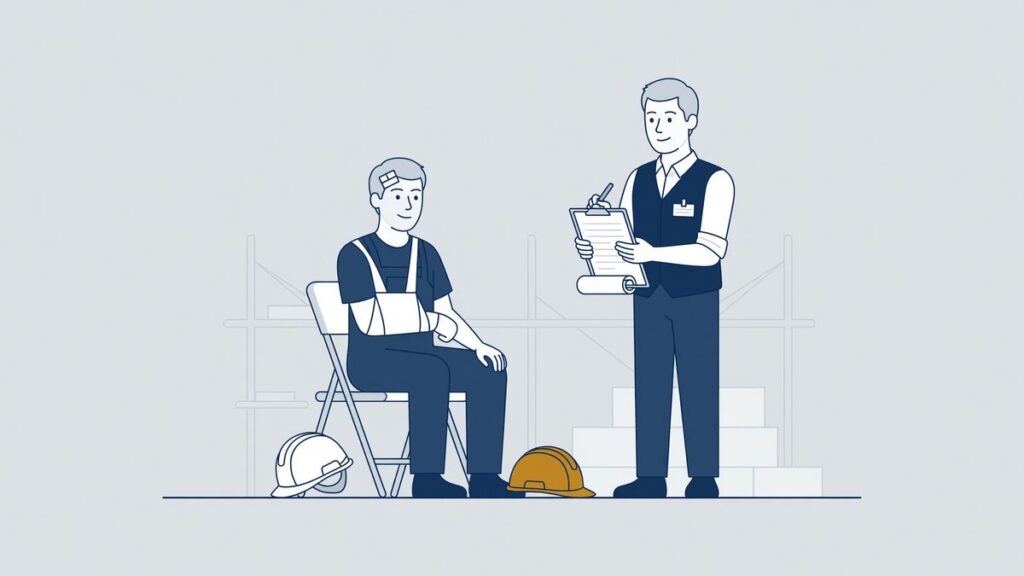

When an employee or other worker is injured at work, it matters greatly that the accident is reported correctly. The legislation on workplace accidents is strict: employers must report serious accidents immediately to the Netherlands Labour Authority.
Yet many employers and employees do not know exactly when an accident must be reported, or what happens next. In this article Arslan Advocaten sets out step by step what the rules are, what you as an employer must do, and what rights a victim has.
When is there a workplace accident?
In short, a workplace accident is an accident that happens during working hours and/or at the workplace. This also covers travel during working hours, for example on your way to a client or to a site for your work. An accident during such a business journey therefore also counts as a workplace accident. Travel to and from home (commuting), however, is as a rule not covered: an accident during those journeys is generally not classed as a workplace accident. An accident on the public road can still be a workplace accident, for example during a business journey.
When must a workplace accident be reported?
A workplace accident must be reported as soon as it is regarded as serious. That is the case where:
-
the employee has to be admitted to hospital, which includes a day admission of only a few hours, for example for an operation or procedure by a specialist; treatment in the emergency department without admission, such as stitches, a plaster cast or a bandage, does not count;
-
there is permanent injury, such as:
-
blindness;
-
amputation of limbs;
-
chronic physical or psychological complaints (such as PTSD);
-
-
or the accident results in death.
Besides these serious cases there are other situations that can amount to a workplace accident. Think of an office worker who falls down the stairs while fetching something, someone who slips on a wet floor at work, or an employee injured while working with dangerous machinery. These examples show how varied workplace accidents can be, from relatively simple falls to incidents involving heavy machinery.
Even where the seriousness of the injury only becomes clear later, the employer’s duty to report remains.
For example, where an employee ends up in hospital a few days after the accident, or turns out to have permanent injury.
When is an injury permanent, and what if the employer is in doubt?
According to the Netherlands Labour Authority, there is permanent injury if objectively verifiable physical or psychological conditions or functional limitations still exist two years after the accident. If permanent injury is reported, the inspectorate first checks whether it has been established by a medical specialist, such as a neurologist, an ENT specialist or a surgeon. The opinion of a physiotherapist or GP alone is not enough for this purpose.
Is the employer unsure whether the accident must be reported? The Labour Authority then advises reporting it anyway; the inspectorate itself assesses whether the duty to report applies. An employer who does not immediately report a reportable accident is in breach of the Working Conditions Act and can be fined.
Note: the cause of the accident makes no difference. Even where the accident was caused wholly or partly by the employee, the employer remains responsible to report it to the Labour Inspectorate.
What role does the employee’s intent or conscious recklessness play?
In principle the responsibility for reporting a workplace accident always lies with the employer. But what if the employee was consciously reckless, or even acted deliberately? In those exceptional cases the employer’s liability can fall away.
That is not easily established, however:
- The employee’s intent or conscious recklessness must be clearly demonstrated by the employer.
- The threshold is very high. Not every clumsy or unwise act qualifies as conscious recklessness.
- Think of situations where an employee deliberately ignores highly dangerous instructions or seeks out risks, knowing that injury is very likely.
Note: in practice employers rarely manage to produce that proof. The starting point therefore remains that the employer is responsible for a safe workplace — even where an employee makes a mistake.
How can a workplace accident be reported?
A serious workplace accident must be reported immediately to the Nederlandse Arbeidsinspectie.
There are two ways:
-
By telephone via 0800-5151
(available 24 hours a day, 7 days a week) -
Online via the reporting form on the Labour Inspectorate’s website
In the case of a fatal accident the Labour Authority asks you to call immediately (+31 70 333 56 78 from abroad); the line is available day and night.
Make sure you have all the relevant details to hand: date, time, location, the people involved and a short description of what happened.
Does the duty to report also apply to self-employed and temporary workers?
In most cases, yes.
Employers must also report accidents involving people who work under their authority, whatever their form of contract.
That means a duty to report can also apply to accidents involving self-employed workers, agency workers or trainees.
It is also worth knowing that this duty of care applies not only to employees on a permanent or fixed-term contract. The duty of care — and with it liability for workplace accidents — also extends to agency workers, interns and, in some circumstances, also to volunteers and self-employed persons (Article 7:658(4) of the Dutch Civil Code). That depends on the actual work and on whether the person was (partly) dependent on the organisation for their safety. For volunteers, the Working Conditions Act, and with it the duty to report, does not in principle apply.
See also:
Workplace accidents and agency workers: risks, rights and what you can do
What if the accident happens on the road?
Not every accident away from the workplace automatically falls under the duty to report.
The rules are as follows:
-
As a rule no duty to report for an accident during ordinary commuting.
-
A duty to report can apply for an accident during a business journey in working hours, such as a client visit or a delivery, if it leads to death, permanent injury or hospital admission.
In short: as soon as the accident happens in the performance of the work, it can be a workplace accident. Whether it must be reported then depends on the consequences: death, permanent injury or hospital admission.
See also:
Liability in personal injury: what you need to know
Company outings and team building: how does that work?
An accident during a company outing or team-building event can also be a reportable workplace accident.
That depends on the following factors:
-
the employer organises and pays for the outing;
-
attendance is wholly or partly compulsory, or is strongly expected;
-
the outing takes place under the supervision of managers.
If the connection with the work is clearly present, the accident is regarded as a workplace accident, and the employer must report it to the Labour Inspectorate if it has led to death, permanent injury or hospital admission.
How do you report a workplace accident? (step by step)
Reporting an accident need not be complicated, but it does need to be done carefully.
Follow this step-by-step guide:
1. Check whether the incident is a workplace accident
Is it an accident at work or during work-related activities, with serious injury or hospital admission? Then it is probably reportable.
2. Arrange immediate assistance
The employee’s health always comes first. Call for medical help and inform the family.
3. Draw up an accident report
Record precisely what happened, what caused it and which safety measures were in place. This report is essential both internally and for the Labour Inspectorate.
Accident register and your own record
Even if the accident is not reported to the Labour Authority, the employer must enter it in the accident register if it led to more than three working days’ absence (Article 9(2) of the Working Conditions Act). The register records at least the nature and date of the accident, and according to the Labour Authority employees may inspect that information. As the employee, ask in writing for a copy or confirmation of what has been recorded about your accident, have factual errors corrected as soon as possible and keep your own statement. If you work through an agency, inform the agency in writing as well.
For the report, your employer only needs to know what is necessary to assess the duty to report, such as a hospital admission or permanent injury (Article 9(5) of the Working Conditions Act). You do not have to share your full medical file for that purpose. Do keep a note of when you told your employer about later medical consequences.
4. Report the accident to the right authority
In case of hospital admission, permanent injury or death: report immediately to the Labour Inspectorate.
In less serious cases: enter the accident in the accident register if it leads to more than three working days’ absence (Article 9(2) of the Working Conditions Act), and inform the insurer where the policy requires it.
See also:
Step by step: claiming after an accident
What happens after the report?
After the report the Labour Inspectorate carries out an investigation, usually as follows:
-
On-site investigation: the site must be left undisturbed.
-
Interviews: the employees involved, witnesses and sometimes surviving relatives are interviewed.
-
Reporting:
-
If safety rules have been breached, the inspector can draw up a fine report. The amount of the fine depends on the violation. In very serious and fatal accidents the inspectorate investigates under the direction of the Public Prosecution Service, and an official criminal report may follow.
-
In most cases, after the first investigation the inspector asks the employer to investigate the accident itself and to submit an employer’s report with an improvement plan. The inspectorate assesses it and investigates further itself if it falls short. In exceptional cases, for example a fatal accident or an accident involving a child or young person, the inspectorate may carry out the investigation itself.
-
How long does the investigation take?
That depends on the seriousness and complexity of the accident. Sometimes the investigation is finished within a few weeks; in more serious cases it can take months.
The inspectorate keeps the employer and those involved informed of progress.
Keep in mind that the Labour Authority’s investigation and your claim for compensation are separate tracks. The inspectorate looks at compliance with the safety rules; it does not decide whether you receive compensation. A fine does not automatically mean that every loss you claim will be paid, and the absence of a fine does not mean that your civil claim fails. Liability under Article 7:658 of the Dutch Civil Code and the extent of your loss are assessed separately. A report by the inspectorate can, however, be useful evidence, so ask for it in good time.
Financial consequences of a workplace accident
The financial impact can be considerable, for employer and employee alike.
Most employers are insured, but the cover differs.
Common heads of loss are:
-
Medical costs: hospital admission, operations, medication, therapy.
-
Rehabilitation and aftercare: for example physiotherapy or psychological support.
-
Loss of income: wage compensation during incapacity for work.
-
Adaptations at the workplace: to make a return to work possible.
In most cases you can recover the loss you suffer in a workplace accident from the employer or its insurer. In principle, it must be established that you suffered the loss in the performance of your work. The employer is then liable, unless it proves that it took sufficient measures and gave sufficient instructions, or that the loss is to a significant extent the result of your intent or deliberate recklessness (Article 7:658(2) of the Dutch Civil Code).
Where the insurance does not cover everything, the employer can be held liable for the remaining loss.
How to hold your employer liable formally is explained in holding your employer liable for an accident at work.
Read more about this:
How does a personal injury claim work?
Is the employer also liable where a colleague caused or contributed to the accident?
Yes. Even where a colleague is wholly or partly responsible for the accident, the employer remains liable in most cases. The law places the responsibility for a safe workplace on the employer — even where one employee’s mistake injures another.
Only in exceptional situations — for example intent or conscious recklessness by the employee — can the employer escape liability. The employer must then prove that the damage is to a significant extent the result of the employee’s intent or deliberate recklessness (Article 7:658(2) of the Dutch Civil Code).
In short: it usually makes no difference who caused the accident; the employer generally remains responsible for the consequences.
When is the employer not liable for a workplace accident?
There are exceptions in which the employer is not liable. That is the case if the employer proves that it took the measures and gave the instructions that were reasonably necessary to prevent the injury, or that the injury is to a significant extent the result of intent or deliberate recklessness on the part of the employee (Article 7:658(2) of the Dutch Civil Code). Think of someone knowingly ignoring safety rules or deliberately putting themselves and others at risk. Importantly, the employer must prove that this was the case, and in practice that is almost always difficult.
Exceptions to the employer’s liability
In most cases the employer is liable for a workplace accident, even where you as the employee were partly at fault. The employer is not liable if it proves that it fulfilled its duty of care. In addition, there are two exceptions related to your own conduct:
- Intent: You caused the accident deliberately.
- Deliberate recklessness: immediately before the accident you were actually aware of the reckless nature of your conduct. That standard is strict.
These are exceptional situations, and the burden of proof lies with the employer. In practice it is rare for an employer to establish intent or conscious recklessness on the employee’s part.
Your rights as the victim of a workplace accident
As an employee you are entitled, after a workplace accident, to:
-
Compensation if the employer is liable: medical costs, loss of income and other losses.
-
Safe working environment: under artikel 7:658 BW the employer must ensure safe working conditions.
-
Support with returning to work: if you cannot work temporarily, the employer must provide appropriate support.
More about compensation:
The advantages of legal assistance in personal injury
Why get legal help?
Claiming personal injury after a workplace accident can be complex.
Many victims want to keep the relationship with their employer intact while still asserting their rights.
Arslan Advocaten takes a careful approach in which both interests are respected.
The first consultation is free of charge. If the employer is liable, reasonable costs of legal assistance can in principle be recovered from the liable party (Article 6:96 of the Dutch Civil Code). That is not a guarantee that all costs will be covered; we discuss the arrangements with you in advance.
Why expert guidance matters
A workplace accident brings uncertainty and stress.
An experienced personal injury lawyer:
-
keeps track of deadlines and procedures;
-
helps obtain the Labour Inspectorate’s reports;
-
and ensures the claim is handled correctly.
That way you avoid mistakes and your claim is based on a complete file.
What we offer at Arslan Advocaten
-
Experienced personal injury lawyers with expertise in employment law;
-
Help with building the file and access to the Labour Inspectorate’s reports;
-
Speed and care: we aim to settle your claim as quickly as is responsible and request advance payments where possible;
-
Free first consultation: where liability is established, reasonable costs of legal assistance can in principle be recovered from the liable party.
Get in touch for legal help
Have you been injured in a workplace accident, or do you want to know whether you have a claim?
Contact Arslan Advocaten on 070 450 0300.
We assess your case free of charge and guide you step by step in recovering your loss.
Related legal services
- More about personal injury
- More about workplace accidents and employer liability
- More about employment law
- More about insurance law
See also
- Employer liability for agency workers
- Settlement agreements for expats: special considerations
- Probation and dismissal during probation: your rights and pitfalls
Frequently asked questions
What exactly counts as a workplace accident?
A workplace accident is an accident that happens during working hours or at the workplace, including business travel. Accidents while commuting are as a rule not classed as workplace accidents.
When must a workplace accident be reported to the Labour Inspectorate?
A workplace accident must be reported where it leads to hospital admission (including a day admission), permanent injury or death. If such a consequence only becomes clear later, the accident must be reported as soon as that is known.
What are examples of accidents that seem minor but must still be reported?
Examples are a fall down the stairs, slipping on a wet floor, or a cut while working. These incidents must also be reported if they lead to a hospital admission, even a day admission, or if permanent injury emerges later.
Does the employee’s intent or recklessness affect the employer’s duty to report?
No. The employer must report every workplace accident that leads to death, permanent injury or hospital admission, even where the employee was reckless. The employee’s conduct only matters for liability: the employer is not liable if it proves that it fulfilled its duty of care, or that the damage is to a significant extent the result of the employee’s intent or deliberate recklessness.
See also: Workplace accident: what now? A complete guide to liability









