
Had an accident at work in the Netherlands? Start with your health and a record of what happened. Tell your employer, preserve evidence and keep a copy of every report. Compensation depends on liability and your loss; reporting an accident does not by itself settle the claim.
- Get medical help and explain that the injury happened at work.
- Write down the date, location, task and people present. Ask for relevant camera footage to be preserved.
- Report the accident in writing to your employer and, if applicable, your employment agency. Request a copy of the accident record.
- Keep payslips, receipts and a dated record of help you need. Do not sign a final settlement before its consequences are clear.
Read the full step-by-step plan, check what not to sign straight away, or request legal help with your workplace accident. Medical records should be sent only through a route agreed with us.
What is a workplace accident?
A workplace accident is an incident that occurs during work or working hours and often results in physical injury. This can range from a fall at the workplace to an accident involving hazardous machinery, or even a traffic accident while you are traveling to a client on behalf of your employer. Workplace accidents occur in all kinds of sectors, from construction and industry to office environments and among professionals on the road.
Examples of workplace accidents:
- A warehouse worker is injured by a falling pallet that was not stacked properly.
- An office worker slips on a wet floor that was not cleaned in time.
- A truck driver is involved in a traffic accident while performing his duties.
- A painter falls from scaffolding that is not properly secured.
Is my employer liable?
After a workplace accident the employer is often liable, but not automatically. Under Article 7:658 of the Dutch Civil Code the employer has a duty of care: it must take the measures and give the instructions that are reasonably necessary to prevent you from suffering damage in the performance of your work. If you do suffer damage while working, it is up to the employer to prove that it fulfilled that duty of care. This includes clear instructions, providing protective clothing or equipment, and monitoring compliance with safety regulations.
When is the employer not liable? There are situations in which the employer is not liable for a workplace accident, such as:
- Deliberate recklessness of the employee: immediately before the accident you were actually aware of the reckless nature of your conduct. That standard is strict.
- The employer has all reasonable safety measures taken to prevent the accident.
- Intent of the employee to cause an accident.
The employer has to prove this itself: it must show that it fulfilled its duty of care, or that the damage is to a significant extent the result of the employee’s intent or deliberate recklessness (Article 7:658(2) of the Dutch Civil Code). Ordinary carelessness or negligence on the part of the employee is not enough.
Steps after a workplace accident
After a workplace accident, it is very important that you take immediate action to protect your rights. Follow these steps:
-
Determine whether it is a work-related accident. A workplace accident occurs during work or working hours. This can be at the workplace itself, but also at another location, for example if you are on your way to a client.
-
Identify the cause. Was the accident caused by a lack of safety measures, insufficient supervision, or a colleague’s mistake? This may be decisive for your employer’s liability.
-
Make sure the Labour Inspectorate is involved. If the accident leads to a hospital admission (including a day admission of a few hours), permanent injury or death, the employer must report it immediately to the Netherlands Labour Authority. If that does not happen, you can inform the Labour Authority yourself by submitting a report or complaint. See also reporting a workplace accident: what are the rules?
-
Note witnesses. Colleagues or other witnesses can be crucial to confirm the circumstances of the accident.
Also report the accident in writing to your employer or supervisor, stating the date, time, place, task and what happened, and ask for confirmation that it has been registered. If you work through an agency, inform the agency as well. Keep the complete message and any reply. Ask in writing for camera footage of the location and time to be preserved; footage is often overwritten after a short time. A colleague who saw you immediately afterwards can also give useful information, even without having seen the accident itself. Ask people to describe only what they observed themselves. Read more in accident at work without witnesses: how do you prove what happened?
-
Assess your losses. Collect all medical expenses, additional costs, lost income, and other losses. This can help later when filing a compensation claim.
-
Hold the employer liable. It’s best to do this with the help of a personal injury lawyer. At Arslan Advocaten we are happy to help you file a claim.
Economic and non-economic compensation
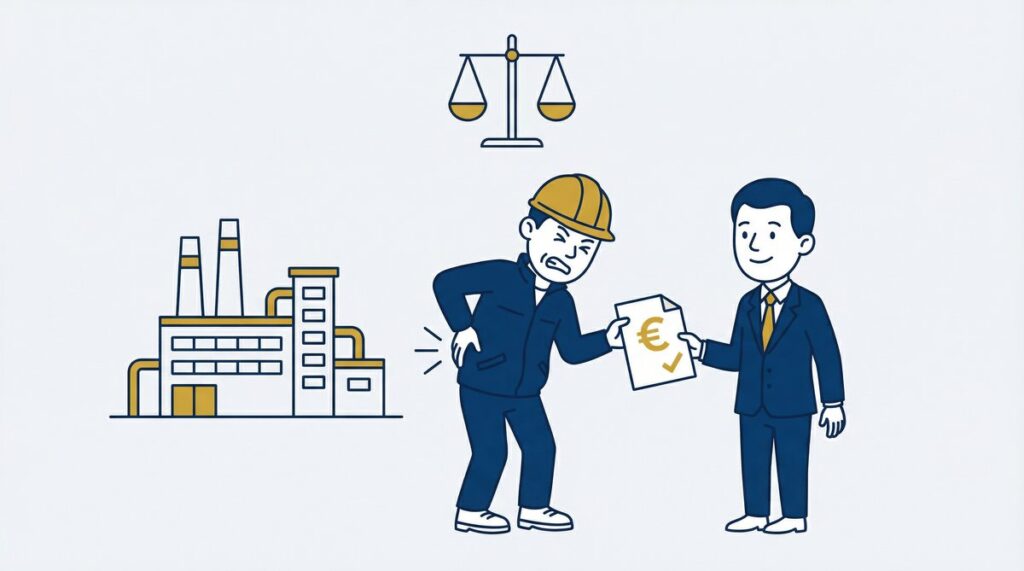
After a workplace accident, you may be entitled to various types of compensation, including:
- Material damages: This includes all direct costs you incur as a result of the accident, such as medical expenses, travel expenses, loss of income, and any costs for modifications to your home.
- Non-material damages (pain and suffering): This is compensation for the emotional and physical pain you have suffered. Think of the impact on your enjoyment of life, long-term pain, or psychological distress caused by the accident.
What you should not sign straight away
Shortly after an accident you may be asked to sign a statement about how it happened, an offer of an advance payment or a settlement agreement. These documents have different consequences. Do not sign anything you do not understand, and ask for an explanation first. If a statement contains a factual error, correct it in writing and keep both the original and the corrected version.
Be especially careful with a settlement that includes final discharge. By signing it you declare that your loss has been settled in full, which usually means you can no longer claim additional loss later, even if your symptoms get worse. If you receive a payment or an advance, write down the amount, the date and what the sender says it is for. That keeps the later calculation of your loss verifiable.
Example: construction worker with serious injuries A construction worker is seriously injured when the scaffolding he is working on collapses because of a structural defect. He has to undergo several operations and remains limited in his physical abilities. Scaffolding must be inspected by a competent person before it is first used and after every change. If that inspection was not carried out properly, it will be difficult for the employer to prove that it fulfilled its duty of care. Compensation can then include medical expenses, loss of income and compensation for pain and suffering. The amount depends on the circumstances of the case.
Legal assistance after a workplace accident
A personal injury case after a workplace accident can be complicated, especially if the employer disputes liability. At Arslan Advocaten we are ready to guide you through the process. We assess your case, hold the right party liable and conduct the negotiations with the insurer, taking your relationship with your employer into account.
If another party is liable, the reasonable costs of out-of-court legal assistance are in principle borne by that party or its insurer (Article 6:96 of the Dutch Civil Code). The first consultation is free of charge and without obligation. We handle the legal procedure and negotiations with the insurer, so that you can focus entirely on your recovery.
Example: temporary agency worker with personal injury
A temporary agency worker at a distribution centre slips on a slippery floor and breaks her hip. She is not employed by the company where the accident happens. Even so, she can hold both the employment agency, as her employer, and the hiring company liable; under Article 7:658(4) of the Dutch Civil Code the hirer can be liable in the same way. Compensation can include medical expenses, loss of income and compensation for pain and suffering.
What to do after a workplace accident?
After an accident, contact a personal injury lawyer in good time. At Arslan Advocaten we assess your rights and the steps needed to recover your loss. Do not wait too long to take action, because time can play a crucial role when filing a claim.
Our approach is personal, expert, and tailored to your situation. We operate nationwide and will come to your home if necessary to discuss your case. Contact us today for a free, no-obligation consultation.
Contact Arslan & Arslan Advocaten or fill in our online contact form and we will contact you shortly.
Frequently Asked Questions
What should I do immediately after experiencing a workplace accident?
You should first ensure your safety, then report the accident to your employer, and seek medical attention if needed. It’s also important to document the incident and identify the cause to support any liability claims.
Is my employer automatically liable if I get injured at work?
Not automatically. If you suffer damage in the performance of your work, your employer is liable unless it proves that it took the safety measures that were reasonably necessary, or that the damage is to a significant extent the result of your intent or deliberate recklessness.
Can I claim compensation if I am injured during travel for work?
Yes, traffic accidents that occur during working hours or while traveling for work can lead to employer liability, and you may be entitled to compensation for your injuries.
What are my rights if I am a temporary agency worker involved in an accident?
As a temporary agency worker, you can hold both the employment agency and the hirer liable for workplace injuries, and you may be eligible to claim compensation from either or both parties.