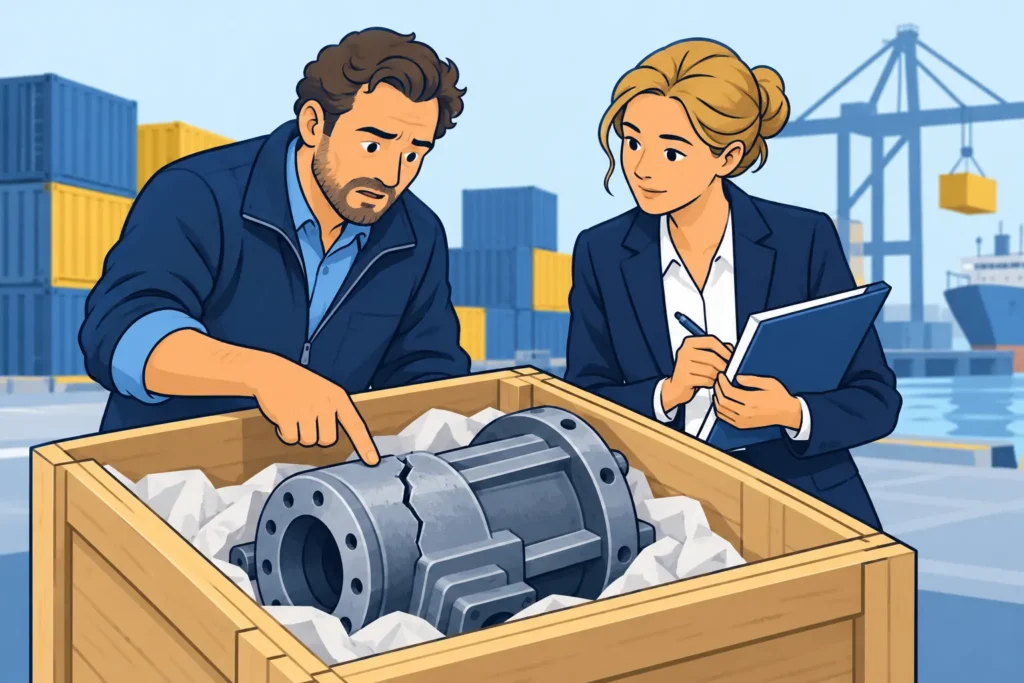
Accidents in a warehouse or distribution centre are rarely caused by a single major mistake. They happen where speed, transport equipment and people on foot meet: at the loading dock, on the walkways and during order picking. That works in favour of your claim, because precisely these areas leave traces in documents your employer is required to keep.
Written by Onur Arslan, attorney at Arslan Advocaten. Registered in the Netherlands Bar’s register of legal specialisations for employment law and personal injury. Content reviewed on 17 September 2026 against the statutory text on wetten.overheid.nl.
Where things go wrong in logistics
| Situation | What is usually going on | Where the evidence lies |
|---|---|---|
| Struck by a forklift truck or pallet truck | No separate walkway, poor visibility because of the load, no acoustic warning signal | Floor plan, risk assessment (RI&E), camera footage, driver’s training certificate |
| Fall from the loading dock | Missing edge protection, lorry pulling away during loading | Photos, maintenance log, dock locking procedure |
| Load falling from the racking | Overloaded racking, no annual inspection, incorrectly stacked goods | Racking inspection report, load signs |
| Back and shoulder complaints from order picking | Excessive picking rates, lifting above shoulder height, no lifting aids | Picking targets, time records, risk assessment on physical strain |
| Trapped in a conveyor belt or stretch wrapper | Guarding removed, emergency stop out of reach, maintenance while running | Maintenance log, manual, LOTO procedure |
| Slipping near the freezer section or the washing line | No anti-slip surface, no markings, cleaning during production | Cleaning schedule, reports in the incident register |
The agency worker in the warehouse
Distribution centres rely heavily on temporary staff, often during peak periods and with a short induction. That makes two things legally important.
First, the hirer is the party that sets up the workplace, provides the equipment and supervises the work. The hirer can therefore be liable under Article 7:658(4) of the Dutch Civil Code (BW), even though you are formally employed by the employment agency. Second, the employment agency must inform you, before you start, about the risks at that specific workplace. Both parties can be held liable alongside each other.
For motorised transport equipment there is also a strict requirement: it may only be operated by employees who have received appropriate training for it. “Just helping out on the forklift because it is busy” does not meet that requirement.
Speed, targets and the duty of care
When it comes to physical strain, people often say: this work is simply heavy. Legally, that is no answer. The employer must organise the work in such a way that health risks are prevented as far as possible, and physical strain is expressly part of that.
In practice, a court looks at questions such as: is there a risk assessment in which lifting and repetitive work have been evaluated, are lifting aids available and are they actually used, is there variation in tasks, and does the picking rate allow the work to be done safely? A system that measures every second while at the same time requiring staff to lift safely will not automatically hold up in court.
Which documents you can request
These are documents that should be available in any warehouse. Request them while the file is still fresh.
- The risk assessment and evaluation with the action plan, and the part that relates to your department.
- The accident register and earlier reports of near misses at the same location.
- Your instruction and training file, including proof of training for transport equipment.
- The maintenance log of the machine or truck involved, and the inspection reports.
- The racking inspection report and the load data.
- The floor plan with walkways and the floor markings.
- Your rota and the picking targets in the period around the accident.
- Camera footage. Request it in writing straight away; it is often overwritten within a few weeks.
If the employer refuses, some of these documents can be obtained through the court. You can also request the report of the Netherlands Labour Authority if it has carried out an investigation.
Working in the logistics regions
A large share of Dutch distribution centres is located around Tilburg, Venlo, Rotterdam and Schiphol. We handle these cases from our offices and, in addition to Dutch, we also speak English and Turkish; for Polish-speaking clients we work with a regular translator. That saves time in a case in which the exact course of events has to be written down precisely.
Have your warehouse case assessed
Has your claim been rejected because you “should not have crossed” or were supposedly “careless yourself”? That defence rarely succeeds. Your own carelessness only cancels out liability in the event of intent or deliberate recklessness, and that threshold is high.
Call 070 450 0300 or send your question via the contact form.
Frequently asked questions
Is anyone in the warehouse allowed to drive a forklift truck?
No. Self-propelled mobile work equipment may only be operated by employees who have received appropriate training for it. If that training is missing, the employer is in a weak position in any dispute about liability.
I was briefly inattentive myself. Am I still entitled to compensation?
Usually, yes. Liability only lapses in the event of intent or deliberate recklessness on the part of the employee, and that threshold is high. The law specifically takes into account that people doing routine work cannot pay attention at every moment.
Can I claim for back problems caused by order picking?
You can, but the causal link is the difficult point here. What matters is the risk assessment for physical strain, your picking targets, the lifting aids available and a medically supported link with the work.
I work through an employment agency. Whom do I hold liable?
You can hold both liable. The hirer sets up the workplace and supervises the work, and is liable under Article 7:658(4) of the Dutch Civil Code. The employment agency is your employer and must inform you about the risks in advance.
How quickly should I request camera footage?
As soon as possible, in writing and stating the date and time window. Many companies only keep footage for a few weeks. You can request footage in which you yourself appear under the GDPR.
Read also
- Workplace accident: when is your employer liable?
- Forklift or wheel loader accident at work: who pays for the damage?
- Personal injury caused by machines and tools: the employer’s duty of care
Further reading on this topic
- Employer uninsured or bankrupt: can you still recover your losses?
- Holding your employer liable after a workplace accident
- Safety instructions and language: was the explanation actually effective?
Sources and legal basis
- Article 7:658 of the Dutch Civil Code (duty of care and liability, including paragraph 4 for hirers).
- Working Conditions Act (Arbeidsomstandighedenwet), Articles 3 (workplace and physical strain), 5 (risk assessment), 8 (information and supervision) and 9 (reporting and registration).
- Working Conditions Decree (Arbeidsomstandighedenbesluit), Chapter 5 (physical strain) and Chapter 7 (work equipment).
- Supreme Court of the Netherlands 23 March 2012, ECLI:NL:HR:2012:BV0616 (Davelaar/Allspan).
Sources checked on 17 September 2026.
This page provides general information and is not legal advice on your own situation. No rights can be derived from its content.